
One of the most rewarding aspects of Constructing Modern Knowledge is the ability to work with some of the world’s leading educational technology experts on personal project development.

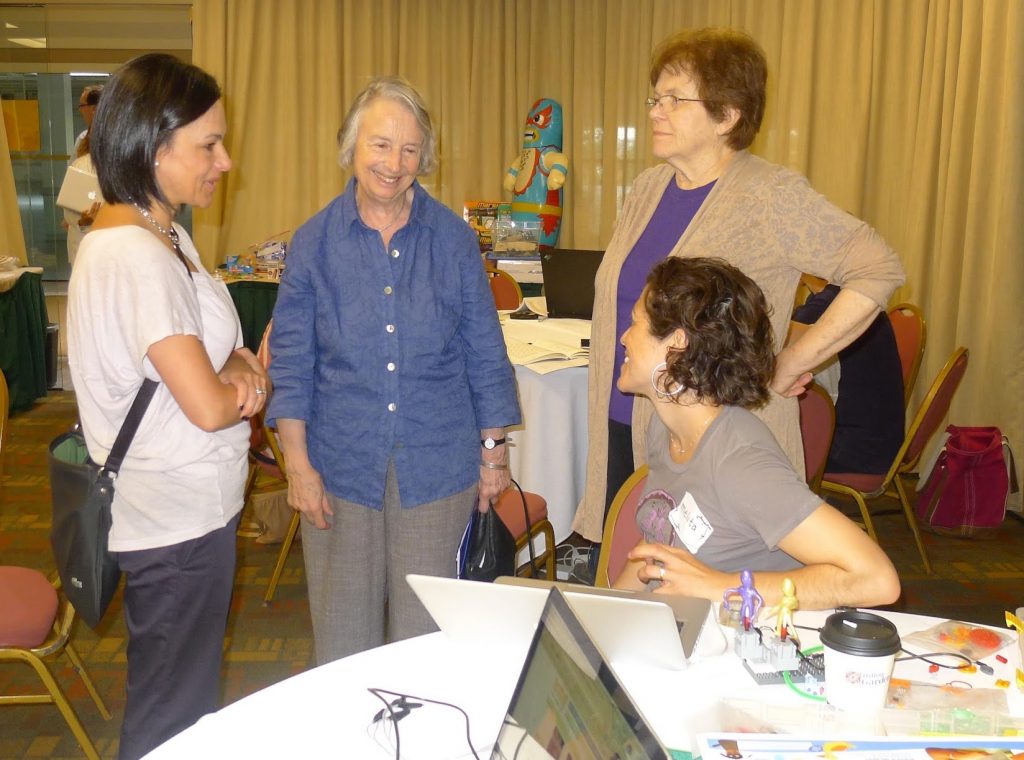


Cynthia Solomon, Ed.D.– 13th year
Senior Fellow: Constructing Modern Knowledge
Dr. Solomon directed the creation of educational materials for the One Laptop Per Child Foundation. She is a pioneer in the fields of artificial intelligence, computer science and educational computing. In 2016, Cynthia was presented with the Pioneer Award from the National Council for Women and Information Technology.
50 years ago while at Bolt, Beranek & Newman, Cynthia, along with Seymour Papert and Wally Feurzig created the first programming language for children, Logo.
She was Vice President of R&D for Logo Computer Systems, Inc. when Apple Logo was developed and was the Director of the prestigious Atari Cambridge Research Laboratory.
Dr. Solomon has maintained a long relationship with the MIT Media Lab and the One Laptop Per Child Foundation in addition to her teaching, consulting and scholarship.Her doctoral research at Harvard led to the publication of the critical book, Computer Environments for Children: A Reflection on Theories of Learning and Education. Cynthia Solomon is also the co-author of Designing Multimedia Environments for Children, with Allison Druin.
Cynthia Solomon’s archive of classic videos about learning and computers, Logothings, may be found here.
Dr. Solomon is the Constructing Modern Knowledge Senior Fellow.

Brian C. Smith – 12th year
Brian C. Smith is Lower School Technology Integrator and Computer Science Teacher at the Spence School in New York City and most recently a teacher at Hong Kong International School. Before that he was an Instructional Technology Specialist for the Monroe #1 Board of Cooperative Educational Services in the Rochester, New York area.
His decades in education have taught him a most important aspect about learning, to enjoy it.Believing that play can be a sophisticated way of learning, Brian has been creating and promoting Math and Inventor’s Playshops teaching both students and educators the power of learning through creative computing. Of particular interest lately has been the DIY phenomenon and the use of Arduino prototyping platform for creating interesting interactive objects and solving problems.
Brian was also a NYSCATE Board Director and has helped plan, organize and coordinate numerous conferences and events, including a Constructivist Celebration at the National Museum of Play.

Josh Burker – 12th year
Josh is the Middle Division Educational Technologist at The School at Columbia University. He earned a BA in English and Education from Colby College and a MA in Educational Technology from Pepperdine University.
An innovative maker educator, his books, The Invent to Learn Guide to Fun in the Classroom and The Invent Guide to More Fun in the Classroom inspire makers of all ages to explore the intersection of crafting and technology through thirteen whimsical, creative projects.

Josh taught and worked in technology in both public and private schools for the past 18 years. He writes books and consults on educational projects that he finds inclusive and disruptive.
During the 2015-16 school he established an after school Logo programming club encouraged inner city students to create knowledge about Logo programming, fabrication, electronics, and art. The students programmed algorithmic designs; created t-shirts from their work; learned how to use and maintain a 3D printer; transformed their designs from digital to 3D printed artifacts; assembled the electronics for a Logo-based robot; 3D printed the robot’s “body”; and launched in depth mathematical explorations as they created beautiful ink drawings from their procedures.
Additionally, Josh led Horizon National’s implementation of a LEGO Community Fund grant to implement LEGO, play-based learning, and STEAM concepts into Horizon’s summer curriculum for K-5. Josh’s projects have been published in Make Magazine as well as in RED, a Spanish education journal. Josh is interested in culture jamming, making sounds, Logo programming and the LogoTurtle robot, and 3D printing.

Tracy Rudzitis – 13th year
Tracy is a veteran educator who spends her days working with students and helping them with their awesome projects.
Tracy’s goal is to provide an opportunity and a space where students can explore ideas in ways that are meaningful to them, use a variety of tools, materials, media, and make things with the innovation and creativity that middle school students are famous for. Tracy also volunteers her time with several after school and weekend coding clubs for kids in the NYC area.
Tracy was named one of “20 Educators to Watch” by the National School Boards Association and is a Senior Fab Learn Fellow at Stanford University.

Jaymes Dec – 8th year
Jaymes Dec is the Director of Innovation for the Franklin School, a new high school in Jersey City with a focus on personalized learning, innovation, and entrepreneurship. Previously, he was the Chair of Innovation at the Marymount School of New York where he developed the first Fab Lab at an all-girls school. Jaymes is an Adjunct professor at Teachers College, Columbia University in the Creative Technologies Certification program. After graduating from the Interactive Telecommunications Program at NYU, he served as the Program Manager at GreenFab, a National Science Foundation program for high school students from the South Bronx that taught science, technology, engineering, and math skills through classes on sustainable design and green technologies. Jaymes was named a “Teacher of the Future” by the National Association of Independent Schools and a Senior Fab Learn Fellow by Stanford University.
Jaymes is the coauthor of Make: Tech DIY: Easy Electronics Projects for Parents and Kids.

Janine Maletsky – 9th year
Janine Maletsky is a retired educator with decades of experience as a tech coordinator and teacher of math, music, and computing. She has led countless hands-on workshops for teachers and and is an irreplaceable member of the Constructing Modern Knowledge team. Janine and Gary Stager have worked closely together across New Jersey, New York City, and CMK events for thirty-five years.
Sylvia Martinez– 15th year
Sylvia Martinez is the co-author of Invent to Learn: Making, Tinkering, and Engineering in the Classroom, known as the “bible” of the classroom maker movement. She is a veteran of interactive entertainment and educational software industries, with two decades of design and publishing experience. She is currently president of Constructing Modern Knowledge Press and Constructing Modern Knowledge, LLC, and is the director of the FabLearn Fellows program out of the Transformative Learning Technologies Lab at the Stanford University Graduate School of Education.
Prior to that, she was president of Generation YES, a non-profit dedicated to empowering students. Sylvia oversaw product development, design and programming as Vice President of Development for Encore Software, a publisher of game and educational software on PC, Internet and console platforms. Sylvia was also involved in the company’s Internet initiatives, including Math.com, the award-winning web site that provides math help to students worldwide.For seven previous years,
Sylvia was an executive producer at Davidson & Associates/Knowledge Adventure, a leading educational software developer.She designed, developed and launched dozens of software titles including Math Blaster: Algebra, Math Blaster: Geometry and Maurice Ashley Teaches Chess. In addition, she was responsible for Educast – the first Internet service for teachers that provided teachers with free news, information and classroom resources.
Before Davidson & Associates, Martinez spent six years as a senior scientist at Magnavox Research Labs, where she developed high-frequency receiver systems and navigation software for GPS satellites.
Sylvia has been a featured speaker at national education technology conferences in areas ranging from the maker movement in education, student leadership, project-based and inquiry-based learning with technology and gender issues in science, math, engineering and technology (STEM) education.
She holds a Master’s in Educational Technology from Pepperdine University and a bachelor’s degree in electrical engineering from the University of California, Los Angeles. Read Sylvia’s popular blog here.
FACULTY, SPEAKERS, AND PROGRAM SUBJECT TO CHANGE